
 +1 877 33 SCALE

White label digital marketing is when one company does the marketing work and another company sells it under its own brand. The client sees your agency. A partner handles the SEO, ads, content, or development behind the scenes. You keep the relationship, the invoice, and the credit.
This guide is for agency owners, consultants, and business owners in the US who are thinking about using a white label partner, or who have been asked by a client for a service they do not offer in-house. It is written by the team at The Scale Agency, a full-service digital marketing agency that also works as a white label partner for other agencies. It covers how the model works, what it costs, what to check before you sign, and when it is the wrong choice.
What is white label digital marketing?
White label digital marketing is an arrangement where a specialist provider delivers marketing services that an agency resells to its own clients under the agency's name. The provider stays invisible. The agency owns the client relationship, sets the price, and presents the results as its own work.
The term comes from retail. A manufacturer makes a product, and a store puts its own label on it. In marketing, the "product" is a service: a monthly SEO campaign, a set of Google Ads, a new Shopify store, a batch of short videos.
Three terms get mixed up, so here is the difference:
• White label: the partner does the work, you sell it as yours. Your client never sees the partner.
• Reseller: you sell another company's product or service, often under their brand or a co-brand. A reseller of a software tool is the common example.
• Outsourcing: you hand a task to an outside team. It may or may not be hidden from the client, and the outside team may deal with the client directly.
A white label marketing agency is a reseller arrangement with one rule added: the end client only ever sees you.
How does white label digital marketing work?
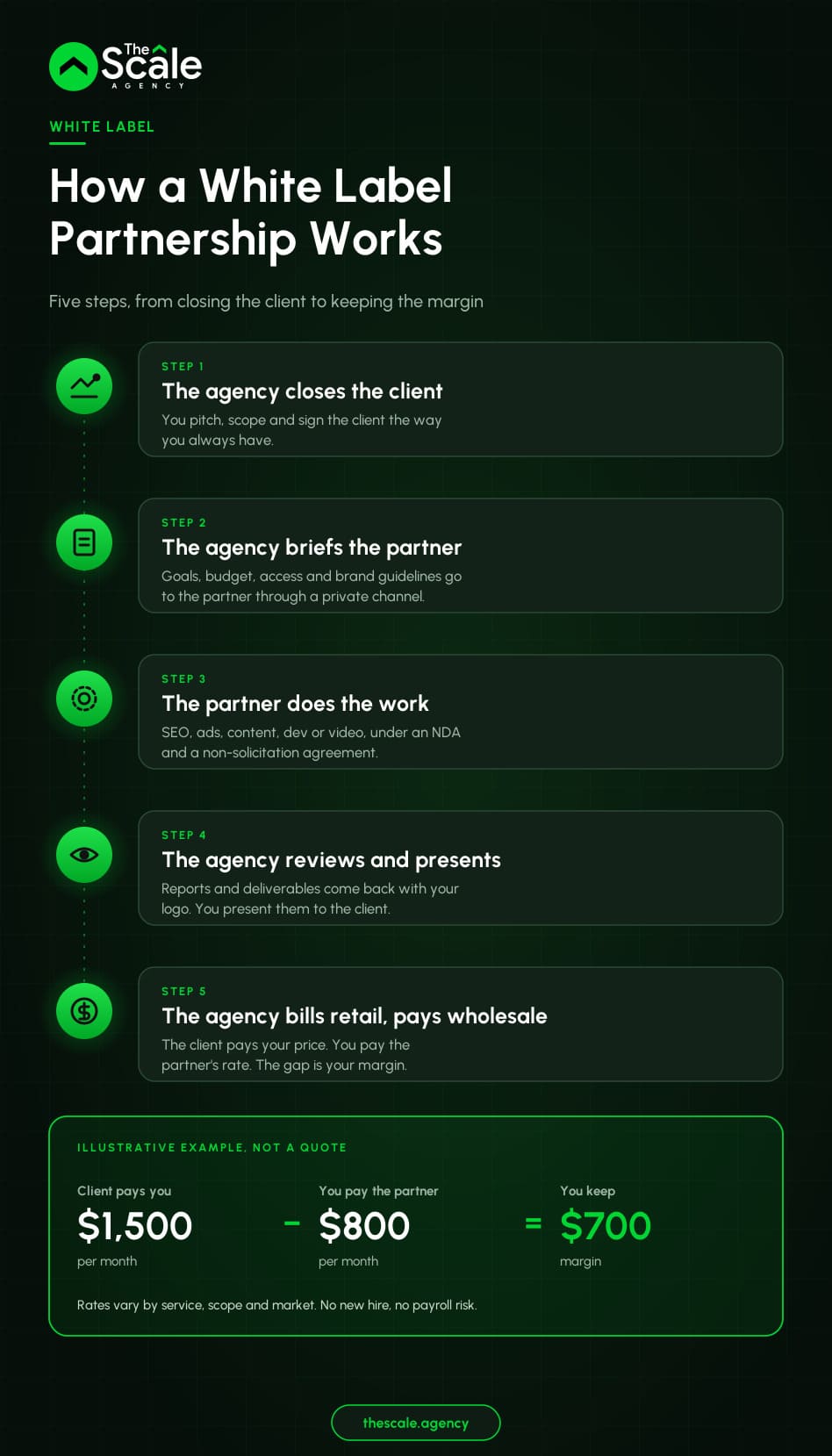
A white label partnership runs in five steps. The agency sells, the partner delivers, and everything the client sees carries the agency's brand.
1. The agency closes the client. You pitch, scope, and sign the client the way you always have.
2. The agency briefs the partner. You share goals, budget, access, and brand guidelines through a private channel.
3. The partner does the work. Keyword research, ad builds, content, dev, video, whatever the scope is. Work happens under an NDA and a non-solicitation agreement.
4. The agency reviews and presents. Reports, dashboards, and deliverables come back with your logo on them. You present them to the client.
5. The agency bills retail, pays wholesale. The client pays your price. You pay the partner's rate. The gap is your margin.
Here is an illustrative example, not a quote. Say an agency sells a local SEO package for $1,500 a month. Its white label partner charges $800 for the same scope. The agency keeps $700 a month for managing the relationship and strategy, with no new hire and no payroll risk. Real rates vary by service, scope, and market, so treat these numbers as a shape, not a benchmark.
Two things make this safe for the agency. The first is a non-solicitation clause, which stops the partner from ever contacting your client directly. The second is branded reporting, so the client never sees a third-party name on a dashboard or an email.
What services can a white label digital marketing agency provide?
Most white label digital marketing services fall into seven groups, and a full-service partner covers all of them. The point is that you can say yes to a client request without hiring a specialist for it.
• SEO: technical audits, keyword mapping, on-page work, internal linking, content strategy, monthly reporting.
• Paid media: Google Search, Display, and Performance Max; Meta and LinkedIn ads; budget and audience management; ROAS reporting. Some agencies call this a white label advertising agency arrangement.
• Content marketing: blogs, landing page copy, product descriptions, email flows, content calendars.
• Video production: Reels, Shorts, and TikTok edits, brand videos, animated explainers, captions.
• Web development: WordPress and Shopify builds, custom front-end work, speed and UX fixes.
• Organic social: Instagram and LinkedIn management, post design, scheduling, community replies.
• Campaign distribution: email automation in Mailchimp or Klaviyo, retargeting pixels, cross-channel tracking.
Newer services are where white label helps most. Few agencies can staff answer engine optimization or AI search visibility work in-house yet, but clients are starting to ask for it. A partner who already does it lets you add the line item this quarter instead of next year.
The mix matters more than any single service. Clients who buy SEO usually need content, and clients who buy ads usually need landing pages. A partner that covers the whole integrated marketing strategy keeps you from juggling four vendors for one account.
Why do agencies use white label marketing services?
Agencies use white label marketing services to grow revenue and client count without growing payroll. Five reasons come up most often.
1. You can say yes to more work. A client asks for paid ads, you only do SEO. With a partner, the answer is "yes, we can start next week," and the account stays with you.
2. No hiring, no turnover. A senior paid media manager in the US is a full salary plus benefits and tools. A white label partner gives you that skill set on a monthly fee that you can scale up or pause.
3. Faster delivery. Specialist teams already have the process, the templates, and the platform accounts. You skip the learning curve.
4. Better margins on new services. You earn the wholesale-to-retail spread without the fixed costs of a new department.
5. Cleaner focus. You spend your time on strategy, sales, and the client relationship, which is where agency value sits. The 360 digital marketing approach only works when someone owns the full picture, and that should be you, not your vendors.
The benefit for the end client is less obvious but real. They get one point of contact and a plan that covers the full digital marketing funnel, instead of stitching together three agencies that do not talk to each other.
White label vs in-house vs freelancers vs referral
White label is one of four ways to deliver a service you do not currently offer. Each trades cost, control, and risk differently.
| White label partner | In-house hire | Freelancers | Referral to another agency | |
| Cost structure | Monthly wholesale fee, scales with work | Salary, benefits, tools, training | Per project or hourly | None; you give the client away |
| Who owns the client | You | You | You | The other agency |
| Speed to start | Days to a few weeks | 2 to 4 months to hire and ramp | Days, if you find the right person | Immediate |
| Quality control | Partner's process plus your review | Full control | Varies by individual | None |
| Risk if volume drops | Low, pause or reduce scope | High, fixed payroll | Low | None |
| Best for | Adding full service lines fast | Core services at high volume | One-off or overflow tasks | Work you never want to offer |
A quick rule of thumb, based on our own agency work rather than a published benchmark: if a service will be more than a third of your revenue in two years, plan to build it in-house eventually. If it is a line item that rounds out the offer, white label it. Some agencies also use staff augmentation, where a dedicated specialist joins your team under your management, as a middle path between white label and hiring.
Which partnership model fits you?
Not every agency wants the same depth of partnership, and good providers offer more than one model. The Scale Agency, for example, structures its white label services in three ways, which map well to the situations most agencies are in:
• Lead referral. You have a lead you cannot serve. You introduce them, the partner handles sales, onboarding, and delivery, and you earn a share of the revenue. Lowest effort, lowest margin.
• Fulfillment for existing clients. You run the account and the relationship. The partner does a specific piece, such as technical SEO while you manage content, or paid media while you handle design. Your client sees no change.
• Full partnership. You get the whole service suite plus sales enablement and onboarding support, from pitch to performance. This is for agencies that want to expand their offer across the board without building internal operations.
Start with the second model if you already have clients asking for something specific. Move to the third when you want to sell new services you have never offered.
How do you keep control of the client relationship?
You keep control by making sure the client only ever hears from you and only ever sees your brand. That takes four practical rules, and they belong in the contract, not in a handshake.
• Non-solicitation and NDA. The partner agrees in writing not to contact, pitch, or disclose your clients. If a provider will not sign this, walk away.
• One point of contact. The partner talks to your account manager, never to the client. Even a "quick clarification call" with the client breaks the model.
• Branded reporting. Dashboards, PDFs, and update emails carry your logo and your tone. Ask to see a sample white label report before you sign.
• A fixed communication cadence. Weekly updates from the partner to you, monthly reports from you to the client. Reporting is the part agencies underestimate; it is the only thing the client sees every month.
How do you choose a white label digital marketing agency?
Choose a white label digital marketing agency by checking its delivery process and its contract terms before its portfolio. Pretty case studies are easy; a clean handoff every month is hard. Ask these ten questions:
1. Which services do you fulfill in-house, and which do you subcontract?
2. Who will actually work on my accounts, and can I meet them?
3. Do you sign a non-solicitation agreement and an NDA?
4. What does a weekly update look like, and what does a monthly client report look like?
5. How do you handle a client escalation or a missed deadline?
6. What are your wholesale rates, and what is included at each tier?
7. How fast can you onboard a new account?
8. Which platforms are you certified or experienced in (Google Ads, Meta, Shopify, WordPress, Webflow)?
9. How do you keep brand voice consistent across my clients?
10. What happens to the account if we end the partnership?
A good partner answers all ten without hesitation. A dedicated strategist, media buyer, analyst, and creative per project, plus weekly updates and reporting, is a reasonable standard to expect from a full-service provider.
Six mistakes agencies make with white label partners
The most common mistake is treating the partner as invisible to you too. The client should never see them; you should see them every week.
1. Choosing on price alone. The cheapest wholesale rate often means offshore volume work with no strategist attached. Thin margins are better than lost clients.
2. Skipping the contract. No non-solicitation clause means your client list is one email away from becoming someone else's.
3. Reselling without adding value. If you only pass work through, the client will eventually wonder what they pay you for. Own the strategy and the presentation.
4. No internal review step. Every deliverable should pass through your account manager before the client sees it.
5. Ignoring reporting until month end. Ask for the partner's weekly numbers so you are never surprised in a client meeting.
6. Overpromising on timelines. Learn the partner's real turnaround before you tell a client "next week."
When white label is the wrong move
White label is the wrong choice when the service is your core identity, when you cannot afford a review layer, or when your client demands to meet every person on the account. An SEO agency should not white label SEO. A two-person shop with no account manager will struggle to review a partner's work properly. And some enterprise clients require full team transparency in their contracts, which the model cannot offer.
It is also a poor fit for one-off tasks under a few hundred dollars. A freelancer is cheaper and simpler for that.
Conclusion
White label digital marketing lets an agency sell more services, serve more clients, and protect its margins without hiring for every specialty. The model works when three things are in place: a signed non-solicitation agreement, branded reporting, and an account manager on your side who reviews everything before the client sees it.


