
 +1 877 33 SCALE

Most growing businesses hit the same wall at some point. Work keeps piling up, the team is stretched thin, and a full-time hire would take months you don’t have. Staff augmentation is one of the most common ways around it.
Staff augmentation means bringing in outside professionals to work as part of your existing team for as long as you need them. You decide what they work on and how it gets done. A staffing provider handles the finding, the screening and, in most cases, the employment paperwork.
This guide covers what staff augmentation is, how it works step by step, the main models, where it helps and where it doesn’t, and examples from marketing, sales, admin and IT teams.
What is staff augmentation?
Staff augmentation is a flexible way to add skilled people to your team without hiring them as your own employees. They join your workflows and take direction from your managers, but they are employed or contracted through a staffing provider. You pay the provider, and the provider pays the worker.
“Augmentation” simply means adding to something. You’re adding skills or capacity to a team that already exists, not replacing it or handing the work to another company.
Staff augmentation meaning in simple terms
Think of it as borrowing a teammate. Say your marketing manager needs someone to run social media for the next six months while you launch a new product line. Instead of posting a job and adding a permanent salary, you bring in an experienced social media specialist through a provider. That person follows your brand guidelines and answers to your manager. When the launch is over, you can keep them, cut back their hours or end the arrangement.
Who manages augmented staff?
This is the part people get confused about most. In staff augmentation, you manage the work. You set priorities, assign tasks, review the output and decide what “done” looks like. The provider manages the employment side: recruiting, screening, payroll, and finding a replacement if someone isn’t the right fit.
That split is what separates staff augmentation from outsourcing, where you ask for a result and the vendor decides how to get there.
How does staff augmentation work?
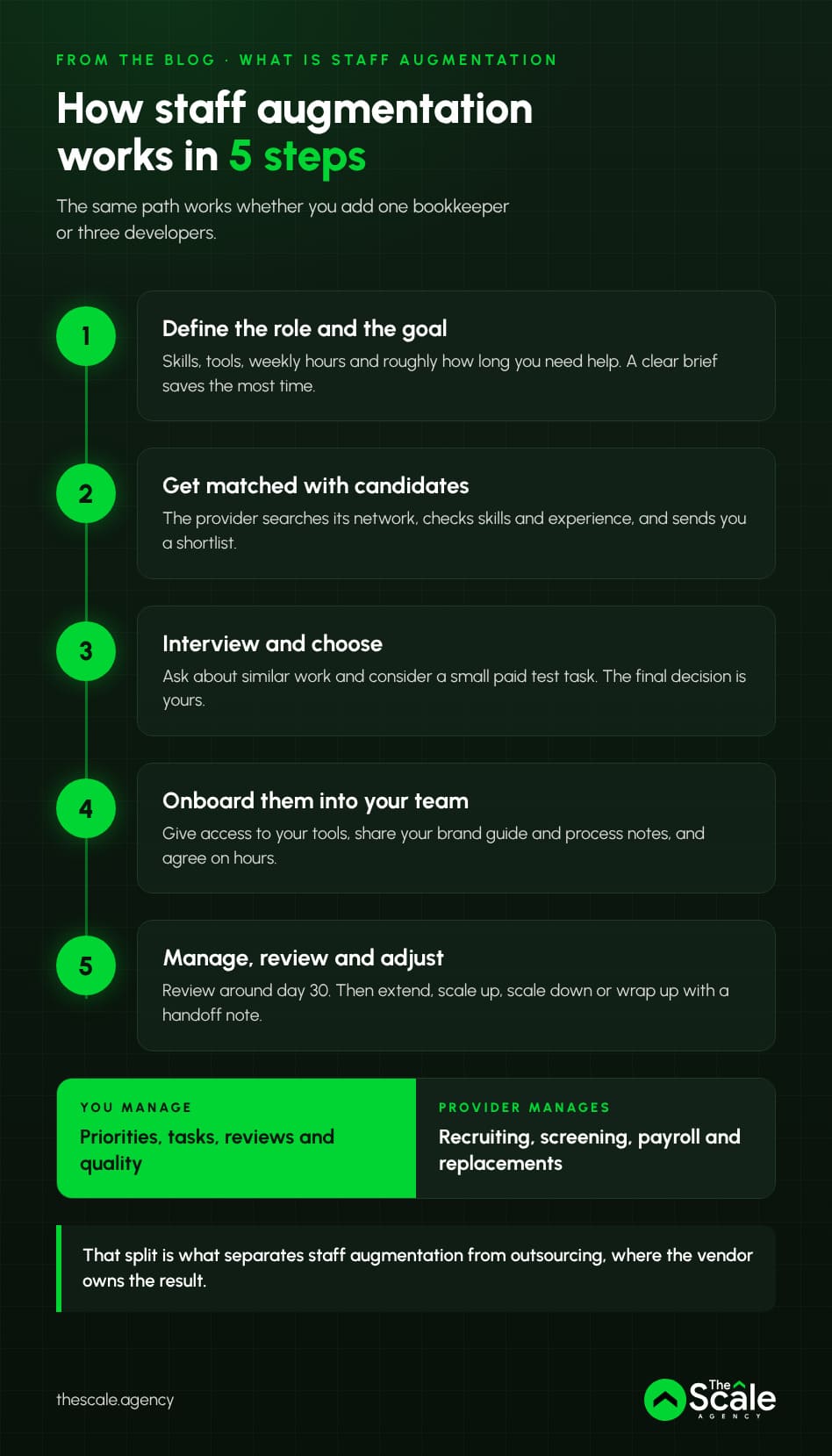
Most arrangements follow the same basic path, whether you’re adding one bookkeeper or three developers.
1. Define the role and the goal. Write down the skills you need, the tools involved, the weekly hours and roughly how long you’ll need help. A clear brief saves more time than anything else.
2. Get matched with candidates. The provider searches its network, checks skills and experience, and sends you a shortlist. This is the step a provider takes off your plate: with The Scale Agency’s staff augmentation services, for example, you describe the role and the team puts forward vetted candidates for you to review.
3. Interview and choose. Talk to the shortlisted people, ask about similar work they’ve done, and consider a small paid test task. The final decision is yours.
4. Onboard them into your team. Set up access to your tools (Slack, Asana, Google Workspace or whatever you use), introduce them to the people they’ll work with, and share the essentials, like your brand guide, process notes and key logins. Agree on working hours and how you’ll communicate, and plan for extra guidance in the first two weeks.
5. Manage, review and adjust. Day to day, the specialist works under your direction. Check in often, and do a proper review around the 30-day mark. Is the work where it should be? From there you can extend, scale up, scale down or wrap up. When an engagement ends, ask for a short handoff note covering what’s in progress and where files live, so the knowledge stays with your business.
Staff augmentation models
“Staff augmentation” covers a few different setups. The right one depends on how long you need help, where the person is based and how much work there is.
Short-term vs long-term augmentation
Short-term augmentation fills a specific gap, such as a product launch, a busy season, a parental leave or a backlog. It usually lasts a few weeks to a few months.
Long-term augmentation is ongoing. Some companies keep augmented specialists for a year or more because the role is needed but doesn’t justify a full-time hire. Some providers also offer contract-to-hire, where you can later bring the person on as an employee, which is worth asking about if a role may become permanent.
Onshore, nearshore and offshore
Onshore means the professional works in the same country as you. For a US business, that’s the US. Nearshore means a nearby country with similar time zones, often Latin America for US companies. Offshore means farther away, usually with a bigger time difference. Location affects cost, overlapping work hours and day-to-day communication, so ask any provider where its people are based.
Individual specialists vs dedicated teams
Most businesses start with one person to fill one gap. Others add a small group that works as a unit, such as a lead generation specialist and an appointment setter working side by side. Either way, your managers still direct the work.
Benefits of staff augmentation
The main benefits of staff augmentation come down to speed, flexibility and control.
• It’s faster than traditional hiring. The provider handles recruiting and screening, so you can usually have someone working in days or weeks rather than months.
• Your headcount can flex. Add help for a busy quarter and reduce it afterward without layoffs.
• You get specific skills when you need them. A paid ads specialist or a Shopify developer can join for a defined stretch without becoming a permanent role.
• You keep control of the work. Because the person works inside your team, you set the standards and priorities directly.
• There’s less admin. Payroll, contracts and replacements typically sit with the provider.
• You can test a role before committing. If you aren’t sure a position needs to be full-time, augmentation lets you find out with real work first.
A word on cost: staff augmentation isn’t automatically cheaper per hour than an employee, because the provider’s rate includes its margin. The savings usually come from skipping recruiting time, not carrying benefits for a temporary need, and lowering the cost of a bad hire.
Challenges and drawbacks of staff augmentation
Staff augmentation has real trade-offs that sales pitches tend to skip.
• You still have to manage. Augmented staff need direction. If nobody has time to assign and review work, a managed service or outsourced project may suit you better.
• There’s a ramp-up period. Even experienced professionals need time to learn your products, customers and processes. Expect slower output at first.
• Knowledge can leave with the person. When an engagement ends, what that person learned goes with them unless you document it along the way.
• Long engagements can cost more. For a role you’ll need full-time for years, hiring directly is often cheaper over time.
• Security needs attention. Give outside workers access only to what their role needs, use accounts your company controls, and make sure your agreement covers confidentiality and ownership of the work.
• Worker classification matters. In the US, how much control a business has over a worker is part of deciding whether that person is an employee or an independent contractor. The IRS looks at behavioral control, financial control and the type of relationship. Ask your provider how its workers are engaged, and have your HR or legal adviser review the agreement.
Real-world examples of staff augmentation
Staff augmentation is often described as an IT practice, but businesses use it across almost every function. These examples are hypothetical, but they reflect situations small and mid-sized US companies face all the time.
Marketing and social media teams
A direct-to-consumer brand with a two-person marketing team is gearing up for the holidays. It adds a social media specialist for four months to handle daily posting, comment replies and scheduling, freeing the in-house team for campaigns and partnerships. After January, it scales back to part-time help.
Sales, lead generation and real estate
A real estate brokerage wants its agents spending time with clients instead of cold-calling. It adds a prospecting specialist who researches leads, makes first contact and books appointments straight into the agents’ calendars. The broker sets the scripts, target neighborhoods and weekly goals, and the specialist works inside the brokerage’s CRM.
Executive, admin and finance support
The founder of a 20-person company keeps spending evenings on email, scheduling and invoices. They bring in an executive assistant for the inbox and calendar, plus a part-time bookkeeper who reconciles accounts and chases unpaid invoices. Both report to the founder.
In each case, the business keeps its own processes and simply adds hands where they’re needed. If one of these sounds like your team, you can add a vetted specialist to your existing team without going through a long hiring cycle.
IT staff augmentation and technical teams
IT staff augmentation is the same model applied to technical roles. You add developers, designers or other technical specialists to your in-house team, and they work under your technical lead in your own tools. It’s the most common use of the model, which is why many guides treat the two terms as the same thing.
Technical roles businesses commonly augment
• Full-stack developers, who work on both the front and back end of a site or app
• Web and mobile app developers
• Ecommerce developers who build and maintain Shopify or Magento stores
• UI/UX designers, who plan layouts and user flows
• SEO specialists who handle technical audits and site structure
Creative roles such as video editors and animators work the same way, joining your content team and working from your brief.
How businesses use technical staff augmentation
Hypothetical examples:
• An online store adds a Shopify developer for eight weeks to rebuild its checkout before peak season.
• A software startup adds two developers to hit a release date without permanently growing its engineering team.
• A company redesigning its website brings in a UI/UX designer for the planning phase.
• A content team adds an SEO specialist to fix technical issues after a site migration.
What to have in place before adding technical staff
Technical engagements go more smoothly when these basics are ready:
• Someone on your side who can review code or design work and make decisions
• Documentation for your codebase, design system or site setup
• Clear access rules, including separate accounts, limited permissions and a plan to remove access when the work ends
• A line in your agreement stating that the work produced belongs to your company
Staff augmentation vs outsourcing, managed services and consulting
The difference comes down to two questions: who manages the day-to-day work, and what are you paying for?
| Option | Who manages the daily work | What you pay for | Best when |
| Staff augmentation | You | People’s time and skills, working inside your team | You need more capacity or a specific skill and can direct the work |
| Outsourcing (project-based) | The vendor | A finished deliverable, such as a website or campaign | You want a defined result without managing how it’s done |
| Managed services | The vendor | An ongoing function run to agreed service levels | You want a whole function, like IT support, handled for you |
| Consulting | You carry out the work; the consultant advises | Expert analysis and recommendations | You need a plan or an outside opinion before acting |
If you want more hands on your team and you’re happy to direct them, staff augmentation fits. If you’d rather someone else own the outcome, outsourcing or managed services make more sense. Agencies that want a partner to deliver whole services under their own brand often use white label partnerships instead.
When should a business consider staff augmentation?
Staff augmentation tends to make sense when:
• You have more work than your team can handle, but you aren’t sure the extra demand will last
• You need a skill for a project or a season, not forever
• Your hiring process is taking too long and the work can’t wait
• Someone on your team can manage and review the new person’s work
It’s probably not the right fit when:
• Nobody has time to direct the work
• You want a vendor to own the result from start to finish
• The role is core, permanent and full-time, in which case hiring directly usually costs less over time
How to get started with staff augmentation
Start small and specific. Pick the one role that would take the most pressure off your team, write a short brief, and decide who will manage the person. Then talk to two or three providers. Ask how they vet candidates, where their people are based, how replacements work and what notice they need to scale down.
If you’d like to see how this works in practice, you can explore staff augmentation roles at The Scale Agency.


