
 +1 877 33 SCALE

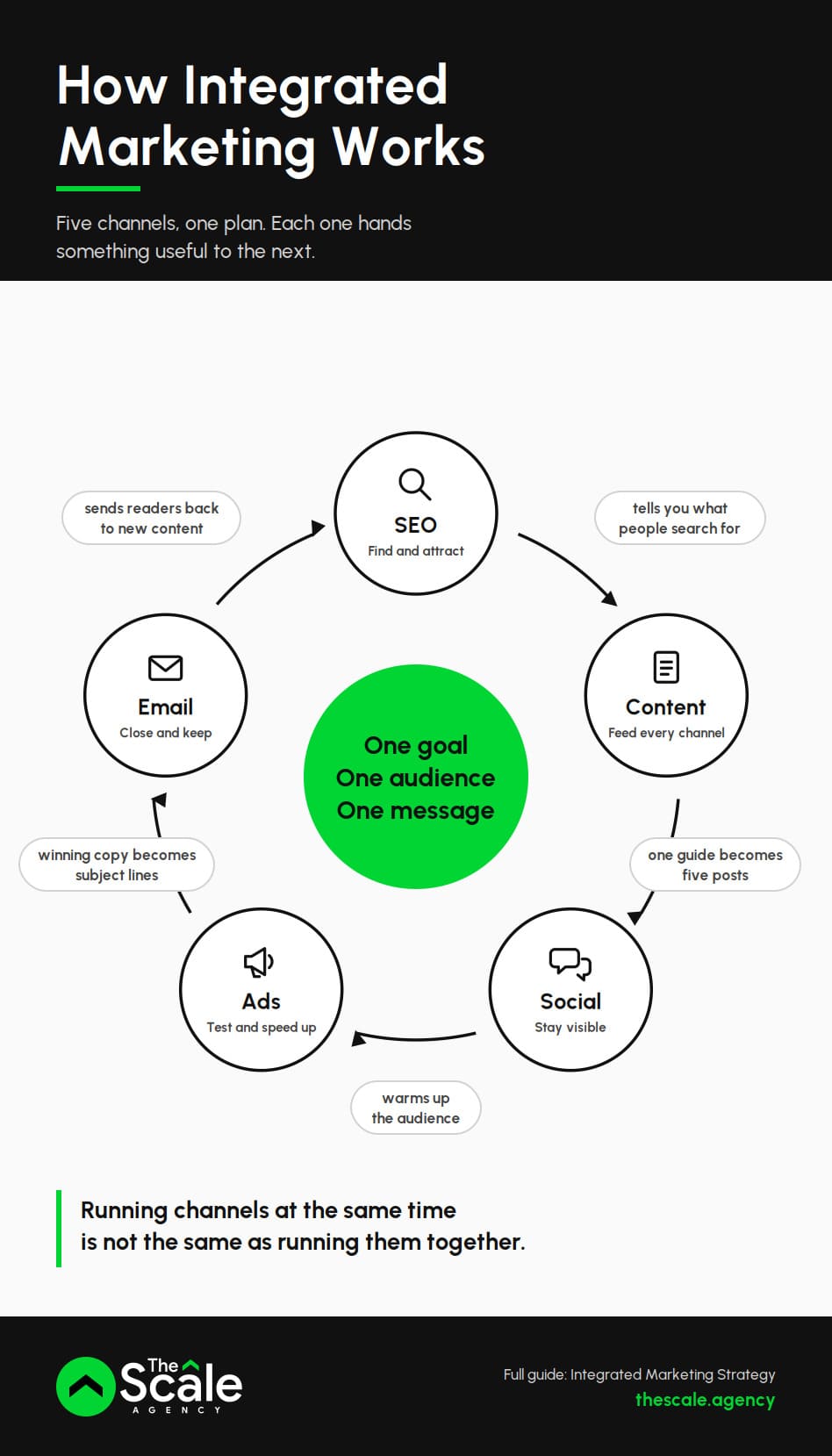
An integrated marketing strategy means your SEO, paid ads, social media, and email all work from one plan, with one message, toward one goal. Instead of four teams doing four separate things, you get one system where each channel feeds the others.
That's the short answer. The longer answer is why most businesses don't have one, and how to build one without blowing up your budget. That's what this post covers.
Quick answer: Pick one goal and one audience. Build one core message. Then give each channel a job: SEO brings people in, ads speed things up, social keeps you visible, and email turns interest into sales. Track it all in one place.
What Is an Integrated Marketing Strategy?
Picture a small agency owner in Charlotte. She runs SEO for a dozen local clients. One Tuesday, her best client calls and says, "Our Google Ads guy quit. Can you take over? Oh, and we need somebody to post on Instagram too."
She can say no and watch the client shop around. Or she can say yes and figure it out.
That phone call is the whole problem in one scene. The client never wanted "SEO" or "ads" or "social." The client wanted customers. The channels are just roads that lead there. An integrated marketing strategy builds all those roads to the same destination.
Here's a plain definition. An integrated digital marketing strategy is a plan where every channel shares the same audience, the same message, and the same goal, and where results get measured together instead of one channel at a time.
That last part matters. Lots of businesses run SEO and ads and email at the same time and call it integrated. It isn't. Running things at the same time is not the same as running them together.
What Are Marketing Silos (and Why Do They Cost So Much)?
Marketing silos happen when each channel runs on its own island. The SEO person chases rankings. The ads person chases cheap clicks. The social person chases likes. The email person chases open rates. Everybody hits their number, and the business still doesn't grow.
Silos usually aren't anyone's fault. They form naturally. You hire a freelancer for one thing, then another for something else, then an agency for a third. Each one reports to you separately, with their own dashboard and their own definition of success.
The cost shows up in a few ways:
- Mixed messages. Your ads promise "fast turnaround" while your blog talks about "careful, detailed work." A customer sees both and trusts neither.
- Wasted spend. You pay for ad clicks on a keyword your blog already ranks first for. Or you run a sale on email that nobody mentions on social.
- Blind spots. The ads team sees a customer click and leave. The email team sees the same person buy two weeks later. Nobody connects the dots, so the ad gets cut for "not converting."
- Double work. Three different people write three different versions of the same product description.
Honestly, the double work alone should bother you. You're paying for the same thinking three times.
Silos are also the main reason people end up looking at 360-degree digital marketing as an alternative. The 360 approach and integration are close cousins. One is about covering every touchpoint. The other is about making those touchpoints agree with each other.
The Benefits of Integrated Marketing (Without the Hype)
You've probably read lists that promise integration will triple your revenue. We won't do that. Here's what you can expect if you do it well.
Each channel makes the others cheaper. When your blog ranks for a topic, you can run smaller ad budgets on that topic. When your ads test a headline and it wins, that headline goes into your email subject lines and your social posts. You stop guessing in four places and start learning in one.
Customers hear one story. Somebody finds you through a Google search, sees your ad later that week, scrolls past your post on LinkedIn, then gets your email. If all four say the same thing in the same voice, you feel familiar. Familiar gets the sale.
Reporting gets honest. When you measure channels together, you see what's really happening. Social might not "convert" on its own, but it might warm up the people who later click an ad. Siloed reporting would have killed social. Integrated reporting keeps it.
Decisions get faster. One plan means one meeting, not four. One owner, not four vendors pointing at each other.
That's the real list of benefits of integrated marketing. No magic. Just less waste and clearer thinking.
How Each Channel Fits Into an Integrated Marketing Plan
This is the part most guides skip. They say "connect your channels" and leave you to figure out what that means. So let's walk through the main integrated marketing channels and give each one a job.
SEO: The Foundation That Compounds
SEO is the slow, steady channel. It takes months, and once it works, it keeps working while you sleep. In an integrated marketing plan, SEO does three jobs. It tells you what people actually search for (which shapes everything else). Google's own SEO Starter Guide is a good place to see how that research works. It brings in traffic you don't pay for per click. And it builds the content library that every other channel borrows from.
Say you run an HVAC company in Phoenix. Your SEO research shows people search "AC repair cost" more than "AC repair near me." That one fact changes your ad copy, your social posts, and your email subject lines. SEO found it. Everyone else uses it.
If your SEO is weak, the whole plan sits on sand. Good SEO services should hand you research the rest of your team can use, not just a ranking report.
Paid Ads: Speed and Testing
Ads are the fast channel. SEO can take months to prove a message works. Ads can prove it by Friday.
That's their best job in an integrated plan: testing. Run two headlines, two offers, two audiences. Find the winner in days. Then push that winner into your organic content, your emails, and your posts. You've just saved months of guessing.
Ads also fill gaps. If you don't rank yet for a keyword that matters, ads can hold the spot while SEO catches up. And they catch the people who visited once and left. Retargeting is just a second chance to finish the conversation.
The mistake is treating ads as the whole plan. Turn off the budget and the traffic stops the same day. Good PPC management knows which keywords to pay for and which ones your SEO already owns.
Social Media: Staying Visible Between Decisions
Most people won't buy the first time they see you. Or the third. Social media keeps you in the room during the weeks or months between "I noticed you" and "I'm ready."
In an integrated plan, social doesn't start from scratch. It takes the blog post SEO built, cuts it into five short posts, and spreads them over two weeks. It takes the ad that won and turns it into an organic post. It shows the faces behind the business so the email that lands next week feels like it came from a person.
Paid social and organic social also split the work. Organic builds trust slowly. Social media advertising puts your best content in front of people who haven't found you yet.
Email: Where Interest Turns Into Revenue
Email is the channel you own. No algorithm decides who sees it. No bidding war. Just you and someone who already said yes to hearing from you.
In most integrated plans, email is where the money shows up. SEO brought them in. An ad brought them back. Social kept them warm. Then an email with the right offer at the right time closes it.
The integration part is simple but often skipped. Your email list should grow from every other channel (a signup box on blog posts, a lead magnet in ads, a link in your social bio). And your emails should send people back out to new content, new offers, and new posts. It's a loop, not a dead end.
Content: The Thread That Ties It Together
Content isn't really a channel. It's the raw material every channel uses. One well-researched guide becomes a ranking page, five social posts, an ad landing page, and two emails.
That's why content marketing sits at the center of an integrated digital strategy. Write once, use everywhere. If your content is thin or off-message, every channel inherits the problem.
What About AI Search? Where AEO and GEO Fit
Not long ago this section wouldn't exist. Now it has to.
More people ask ChatGPT, Perplexity, and Google's AI Overviews for recommendations instead of scrolling through ten blue links. If your business doesn't show up in those answers, you're missing a growing slice of your audience.
Answer engine optimization is about structuring your content so AI tools can pull clear, direct answers from it. Generative engine optimization goes a step further and focuses on getting your brand cited and recommended inside AI-generated responses.
Here's why they belong in this post. AEO and GEO aren't separate channels you bolt on. They're an extension of your SEO and content work. The same clear writing, the same well-organized pages, the same consistent brand facts across the web. If your channels already agree with each other, AI tools find it much easier to trust and repeat what you say. Silos make you invisible to them.
How to Build an Integrated Marketing Strategy in 7 Steps
You don't need a 40-page deck. You need these seven steps and a few honest conversations.
Step 1: Pick One Goal
Not five goals. One. More qualified leads this quarter. More repeat purchases. More booked consultations. Write it down with a number attached.
Every channel decision after this gets tested against that goal. If a channel can't explain how it helps, it waits.
Step 2: Know Exactly Who You're Talking To
One primary audience. A real description, not "small business owners." Try "owners of two-to-five-location dental practices who handle their own marketing and are tired of it."
The sharper the picture, the easier it gets to write one message that works everywhere.
Step 3: Write One Core Message
What do you want people to believe about you after they've seen you three times? Put it in one or two sentences. Then make sure your ads, posts, pages, and emails all point back to it.
They don't have to use the same words. They have to make the same promise.
Step 4: Give Each Channel a Job
Use the roles above as a starting point. SEO finds and brings in. Ads test and speed up. Social keeps you visible. Email closes and keeps customers. Content feeds them all. Adjust for your business, but make sure every channel has a clear reason to exist.
Step 5: Build One Content Calendar
One calendar. Not an SEO calendar, an email calendar, and a social calendar that never talk. When a blog post goes live, the calendar already shows the three social posts, the email mention, and the ad test that follow it.
This single change kills more silos than anything else on this list.
Step 6: Track Everything in One Place
Set up one dashboard that shows how all channels move the goal from Step 1. Use UTM tags on every link so you know where people came from. Google Analytics 4 can show you the paths people take across channels before they convert, which is exactly the view silos hide.
If each vendor sends you a separate PDF every month, you don't have integrated marketing. You have four reports.
Step 7: Meet Monthly and Move Budget
Look at the dashboard together. What's working? Shift money toward it. What's stalled? Fix it or pause it. Treat your budget like water, not concrete.
Integrated Marketing for Small Business: What If You Can't Afford Everything?
Fair question. Most of what you read about integrated online marketing strategies, or cross-channel marketing strategy, assumes a team of eight and a six-figure budget. You might have yourself, a part-time helper, and a few hundred dollars a month.
Integration still works. It just means picking fewer channels and connecting them tightly.
Start with two. For most small businesses, that's SEO (or local SEO) plus email. Both are cheap to run and both keep working over time. Write one helpful blog post a month. Put a signup box on it. Send one useful email a month to the people who sign up.
When that loop runs smoothly, add one more. Usually a small retargeting ad budget to bring back the people who read but didn't sign up. Then organic social, built from the blog content you already have.
Integrated marketing for small business is really about discipline, not budget. Two channels that share a plan beat five channels that don't.
Should You Build This In-House or Get Help?
You have a few options, and the right one depends on your size.
Do it yourself. Fine if you're small and you have the time. The seven steps above are enough to start.
Hire specialists for each channel. This is how most businesses end up with silos. It can work, but only if you act as the integrator. That's a real job, and it's usually the one that gets dropped.
Add people to your own team. If you have a marketing manager who already holds the plan but not enough hands to run it, staff augmentation fills the gaps without a long hiring process.
Work with one team that covers every channel. This is the option that makes integration easiest, because the people running SEO, ads, social, and content already sit in the same room. For agency owners, white label services let you offer the full set to your clients without hiring for each one. That Charlotte agency owner from the start of this post? This is how she says yes.
At The Scale Agency, we built our structure around this idea, with separate teams for SEO, paid media, video, and web that run from one plan and report into one dashboard. It's one way to solve the problem. Not the only way.
Common Mistakes to Avoid
A few things we've watched trip people up:
- Same content, pasted everywhere. Integration means the same message, not the same words. A LinkedIn post and a Google ad shouldn't read the same.
- Launching all channels at once. Start with two that connect well, prove the loop, then expand.
- Measuring each channel on its own. If social gets judged only on direct sales, it'll always look bad. Judge the system.
- No single owner. Somebody has to hold the whole picture. If that's nobody, it's silos again within six months.
- Forgetting the message. Teams get busy with tactics and forget what they're trying to make people believe. Reread Step 3 every quarter.
One Thing to Do This Week
Pull up your last ad, your last email, your last social post, and your top-ranking blog page. Read them back to back.
Do they sound like the same business, making the same promise, to the same person? If yes, you're closer to an integrated marketing strategy than you think. If no, you just found the first thing to fix.
And if you'd rather have someone map the whole thing out with you, book a free strategy session. We'll look at your channels, find where they're fighting each other, and show you what to connect first.


