
 +1 877 33 SCALE

A business owner in Dallas searches "why is my commercial AC bill so high" and lands on a blog post. She reads it and closes the tab. Two weeks later she downloads a maintenance checklist from the same company. A month after that, she booked a consultation. That path, from a question to a decision, is what the funnel describes.
A digital marketing funnel is a model of how a potential customer moves from first hearing about your business to deciding to buy, across digital channels, in three stages: TOFU, MOFU, and BOFU. Each stage has its own buyer mindset, content, channels, and numbers to watch.
This guide explains what each stage does, which channels and content fit where, how the marketing funnel differs from the sales funnel, how to measure and fix a funnel, and what a simple version looks like for a small business.
What is a digital marketing funnel?
A digital marketing funnel is a framework for matching your marketing to where a customer is in their decision. People at the top are learning about a problem. People in the middle are comparing ways to solve it. People at the bottom are choosing who to buy from. The shape is a funnel because fewer people reach each stage than entered the one before.
The idea descends from the AIDA model (Attention, Interest, Desire, Action), which is more than a century old. Some frameworks split the funnel into six or seven stages; most working marketers use three.
Why bother with stages? Because they show where to spend and where you lose people. If your blog brings readers but your site never captures an email, you have a MOFU problem, not a traffic problem. Without stages, every result looks like "marketing isn't working."
One caution: the funnel is a model, not a map of every customer's path. Real buyers skip steps, loop back, and research in channels you cannot see. Treat the funnel as a planning tool that covers the first three stages of the full customer journey, including retention and advocacy, which comes after the sale.
What TOFU, MOFU, and BOFU mean
The three acronyms describe where a person sits in the funnel:
• TOFU stands for top of funnel. The buyer is becoming aware of a problem or a need.
• MOFU stands for middle of funnel. The buyer is considering options.
• BOFU stands for bottom of funnel. The buyer is deciding whom to choose.
| Stage | Buyer mindset | The question they are asking | Your goal | Content that fits | Channels that fit | Keyword type | Lead KPI |
| TOFU (awareness) | "I have a problem." | "Why is this happening and what are my options?" | Reach the right people and earn attention | Blog posts, how-to guides, short videos, social posts | SEO, organic and paid social, video, display | Broad, non-branded, informational | Reach, organic traffic, branded searches |
| MOFU (consideration) | "I am comparing solutions." | "Which approach fits my situation, and who can I trust?" | Capture contact details and build trust | Comparison guides, checklists, webinars, case studies, email sequences | Email, content, retargeting | Long-tail, comparison, "best" and "vs" queries | Leads, cost per lead, email engagement |
| BOFU (decision) | "I am ready to choose." | "Why this company, and what happens next?" | Remove friction and convert | Consultations, demos, pricing pages, testimonials, estimates | Paid search on commercial terms, retargeting, your website | Branded, commercial, local "near me" | Conversion rate, cost per acquisition, revenue |
The three stages of a digital marketing funnel
The marketing funnel stages are a sequence, but they are also content categories. A business publishes TOFU, MOFU, and BOFU content at the same time, because visitors arrive at every stage, every day.
TOFU: top of funnel (awareness)
At the top of funnel, the person does not know your company and may not know they need one like yours. They have a question. Top of funnel marketing answers it without asking for anything in return.
The best TOFU content is useful on its own: an explainer, a how-to video, a checklist, a social post that teaches one thing. The keywords are broad and informational, which is why SEO does most of the heavy lifting here. An SEO program built around funnel-stage keywords maps every target term to a stage before any writing starts, so awareness content is not accidentally written like a sales page.
The step into the next stage is something the reader can do right away: a related guide, a checklist download, a newsletter. Without that step, awareness traffic leaves the way it came.
In Dallas, the blog post on high AC bills is TOFU content; it ends with a link to a maintenance checklist.
MOFU: middle of funnel (consideration)
In the middle of funnel, the person knows the problem and is weighing solutions. Middle of funnel marketing has two jobs: capture a way to stay in touch, and build enough trust that your company makes the shortlist.
Lead capture usually happens through a lead magnet, an asset worth an email address: a comparison guide, a cost calculator, a template, a webinar. Trust is built through lead nurturing: case studies, honest comparisons, and a short email sequence that answers the questions people ask before they buy. This is also where a lead is qualified. A marketing-qualified lead (MQL) is someone who has shown enough interest, through downloads or page visits, to be worth a follow-up.
Capturing and qualifying those leads is the job of lead generation management, not the blog post that attracted them. Agencies offering content marketing services usually plan which asset serves which stage before they write a word.
Back in Dallas: the maintenance checklist is the lead magnet. It triggers a four-email sequence about choosing a commercial HVAC maintenance plan.
BOFU: bottom of funnel (decision)
At the bottom of funnel, the person is ready to choose. Bottom of funnel marketing removes the last reasons to hesitate. That means clear pricing or a clear estimate process, testimonials and reviews, a case study close to their situation, and an easy way to book.
The keywords here are commercial and often branded: "commercial HVAC maintenance Dallas," "[your company] reviews," "[competitor] vs [you]." Retargeting and branded search are where managed PPC campaigns earn their keep, because they put your offer in front of people who have already visited. A lead who is ready for a sales conversation becomes a sales-qualified lead (SQL).
Every channel ends on your site, so a conversion-focused website is the BOFU asset you cannot skip. Live client reviews on that site do more than a paragraph of claims.
In Dallas, the fourth email links to a case study and a consultation page. The owner books a call.
Marketing funnel vs. sales funnel
Business owners often use the terms interchangeably, and in a five-person company the difference is small. They cover different stretches of the same journey.
| Marketing funnel | Sales funnel | |
| Owned by | Marketing | Sales |
| Starts with | Someone who has never heard of you | A qualified lead handed over by marketing |
| Ends with | A marketing-qualified lead (MQL) | A closed deal |
| Key metric | Cost per qualified lead | Close rate and deal size |
| Handover | MQL becomes SQL when sales accepts the lead | — |
The marketing funnel covers TOFU, MOFU, and the first part of BOFU. The sales funnel takes over once a person is talking to someone on your team. Agree on what an MQL is and write it down, or leads fall into the gap between the two teams.
Which channels work at each stage
No channel belongs to one stage; each has a different job at each, and the common mistake is expecting one channel to do everything.
| Channel | TOFU job | MOFU job | BOFU job |
| SEO | Rank for broad, informational questions | Rank for comparison and "best" queries | Rank for branded, local, and commercial terms |
| Paid search | Usually costly on broad terms; use sparingly | Comparison terms, competitor terms | Branded and high-intent terms, retargeting |
| Paid social | Reach new audiences with educational creative | Retarget site visitors with case studies | Retarget leads with offers and testimonials |
| Organic social | Build familiarity and distribute content | Share proof and customer stories | Answer objections publicly |
| Newsletter for new subscribers | Nurture sequences, segmented by interest | Consultation reminders, proposals, follow-ups | |
| Content | Explainers, how-tos, videos | Guides, comparisons, webinars, calculators | Case studies, pricing pages, FAQs |
| Website and landing pages | Fast, readable article pages | Lead-capture pages and forms | Consultation, demo, estimate, and checkout pages |
Paid social campaigns are a good illustration: the same platform reaches strangers at TOFU and retargets warm leads at BOFU, with different creative and budgets. For the plan that connects channels under one goal, see how SEO, ads, social, and email work together.
A digital marketing funnel example
Here is the Dallas example as a template you can copy. The company is a fictional commercial HVAC contractor; the structure applies to most US service businesses.
| Stage | Asset | Next step offered |
| TOFU | Blog post: "Why is my commercial AC bill so high?" (ranks for the question) | Download the commercial HVAC maintenance checklist |
| MOFU | Checklist (lead magnet) plus a four-email sequence on choosing a maintenance plan | Read a case study from a similar building |
| BOFU | Case study plus a consultation page with clear pricing ranges and reviews | Book a 20-minute site assessment |
Three things make this work. Every asset answers the question the buyer has at that moment. Every asset offers exactly one next step. And each transition can be measured: how many readers download, how many downloaders read the case study, how many book.
The same shape fits other business models. An eCommerce store runs TOFU buying guides, MOFU comparison pages and abandoned-cart emails, and BOFU product pages with reviews. A B2B software company runs TOFU explainers, MOFU webinars and ROI calculators, and BOFU demos. A local home services company runs TOFU "how much does X cost" posts, MOFU estimate forms, and BOFU "near me" ads backed by Google Business Profile reviews.
B2B vs. B2C funnels
The stages are the same; the weight on each stage changes.
| B2B | B2C | |
| Cycle length | Often weeks to months | Often minutes to days; longer for big-ticket purchases |
| Decision-makers | Several; often a committee | One person, sometimes a household |
| Heaviest stage | MOFU: long consideration, lots of proof needed | TOFU and BOFU: get attention, then make buying easy |
| Typical BOFU asset | Consultation, demo, proposal | Product page, offer, checkout |
| KPI emphasis | Cost per qualified lead, pipeline value | Conversion rate, average order value |
A B2B company that under-invests in MOFU gets leads who are not ready and a sales team that complains about quality. A B2C brand that over-invests in MOFU adds friction to a purchase that should take one visit.
How to build or improve a digital marketing funnel
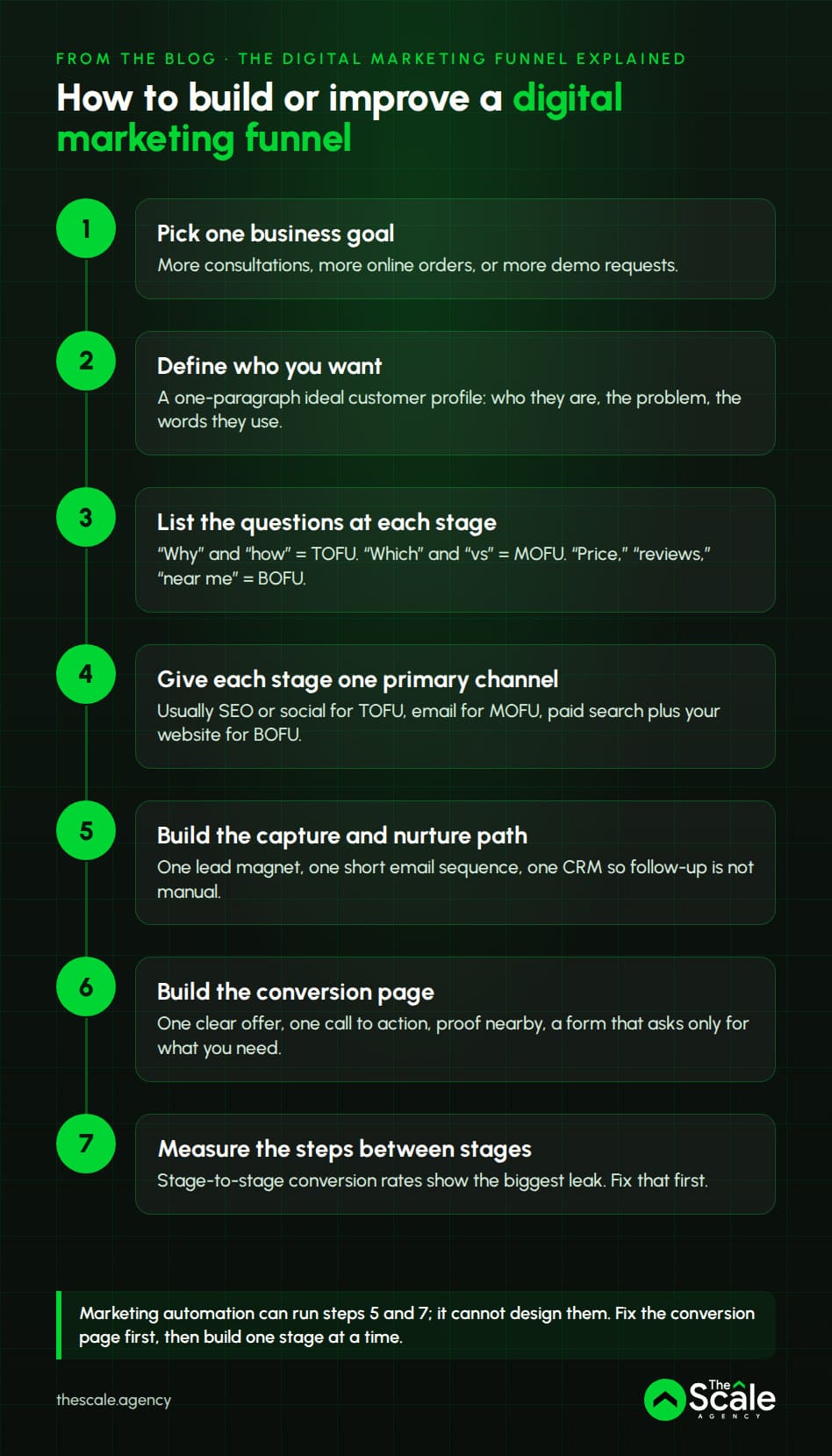
Whether you are starting from scratch or fixing what you have, building a digital marketing funnel follows the same steps.
1. Pick one business goal. More consultations, more online orders, more demo requests.
2. Define who you want. Write a one-paragraph ideal customer profile: company size or household type, the problem they have, the words they use to describe it.
3. List the questions they ask at each stage. "Why" and "how" questions are TOFU, "which" and "vs" questions are MOFU, "price," "reviews," and "near me" are BOFU.
4. Give each stage one primary channel. Usually SEO or social for TOFU, email for MOFU, paid search plus your website for BOFU.
5. Build the capture and nurture path. One lead magnet, one short email sequence, one place where leads land in a CRM so follow-up is not manual.
6. Build the conversion page. One clear offer, one call to action, proof nearby, and a form that asks only for what you need.
7. Measure the steps between stages and fix the biggest leak first. The stage-to-stage conversion rates tell you where to work next.
Marketing automation can run steps five and seven; it cannot design them.
A simple funnel for small businesses
You do not need every channel. A minimum viable funnel has four parts: one TOFU channel, one lead magnet, one email sequence of three to five messages, and one conversion page.
Start at the bottom, not the top. If people who are ready to buy cannot find your pricing, your reviews, or a working form, more awareness traffic will leak out the same hole. Fix the conversion page, add the lead magnet and sequence, then add the TOFU channel. For most small businesses that first channel is SEO, because it compounds; an SEO strategy for small businesses walks through picking those first keywords. For splitting a small budget across channels, the small-business section of our integrated marketing guide covers the trade-offs.
How to measure your funnel
A funnel that is not measured by stage gets judged on the wrong numbers. The most common error is judging awareness content on sales and concluding it failed, when it was never designed to sell.
| Stage | KPIs to track | What a bad number tells you |
| TOFU | Impressions, organic sessions, new users, video views, branded search growth | You are not reaching the right people, or not enough of them |
| MOFU | Leads, lead-to-MQL rate, cost per lead, email open and click rates | Content is not earning trust, or the offer is not worth an email |
| BOFU | Conversion rate, SQLs, cost per acquisition (CPA), return on ad spend (ROAS) | The conversion page or the offer has friction |
| Cross-funnel | Stage-to-stage conversion rates, customer acquisition cost (CAC), customer lifetime value (CLV) | Shows which step is leaking and whether customers are worth what they cost |
One warning about attribution. Last-click reporting gives all the credit to the final click before a conversion, which is usually a BOFU channel, so TOFU looks useless. Check assisted conversions and conversion-path reports in your analytics before cutting an awareness channel. CAC is marketing and sales spend divided by new customers in the same period; CLV is the profit a customer brings over the relationship.
When traffic is healthy but a stage-to-stage rate is low, the fix is conversion rate optimization on the pages where leads drop: clearer offers, shorter forms, proof placed next to the call to action, faster pages.
Common funnel mistakes
• All TOFU, no capture. Lots of blog traffic, no lead magnet, no email list. Fix: add one downloadable asset to your top three posts.
• Selling at the top. A hard pitch on an awareness article. Fix: answer the question first; offer the next step, not the sale.
• No MOFU at all. Awareness content links straight to "contact us." Fix: add one comparison guide and a short nurture sequence.
• One call to action for everyone. The same "Get a quote" button on every page. Fix: match the CTA to the stage.
• Judging every channel on last-click. Fix: review conversion paths quarterly before reallocating budget.
• Stopping at the sale. No onboarding, no review request, no referral ask. Fix: treat the sale as the start of retention.
Does AI change the funnel?
The stages still exist, but the top is changing. When an AI answer covers the basics of a question, the person who clicks through is more likely to be comparing options already, which means more first visits land at MOFU rather than TOFU. Check which pages new visitors enter on; if comparison and pricing pages are rising, plan for it. It also raises the value of being a source an AI answer cites, which is the point of answer engine optimization.
The bottom line
A digital marketing funnel gives every piece of marketing a job. TOFU earns attention, MOFU earns trust and contact details, BOFU earns the decision, and the steps between them are where most businesses lose customers. Fix the conversion page first, build one stage at a time, measure the rates between stages, and repair the biggest leak before adding anything new.
If you would rather have one team plan and run all three stages, see our full-funnel digital marketing services. Not sure which stage is leaking? Talk to our team about your funnel.


