
 +1 877 33 SCALE

Digital marketing services are the paid, professional ways a business gets found online, brings in customers, and keeps them. There are ten services most business owners will ever be offered, and they fall into four groups: services that get you found, services that buy attention, services that convert and keep customers, and services that tell your story.
This guide explains each one in plain terms and ends with a simple way to decide which two or three you need first. If you would rather have one team handle the whole set, a full-service digital marketing agency does that, but the point here is to help you choose.
What are digital marketing services?
Digital marketing services are the specialized tasks a business pays an agency, freelancer or in-house team to do so that it shows up online and turns visitors into customers. They include search engine optimization, paid advertising, content, email, website work, conversion optimization and video. Each one reaches people through a different digital marketing channel, and each one solves a different business problem.
A useful way to sort them is by where the attention comes from. Paid media is attention you buy (ads). Owned media is what you control (your website, your email list, your content). Earned media is what other people say about you (reviews, mentions, shares). It is a framework for thinking, not an official list of services, but it explains why some services cost money every month and others compound.
How many types of digital marketing services are there?
You will see lists of four, seven, ten or twelve types of digital marketing depending on who is counting. For a business owner deciding where to spend, ten services in four groups cover almost everything you will be pitched: three that get you found (with AEO and GEO as a newer layer on top), two that buy attention, three that convert and keep customers, and one that tells your story.
Services that get you found
Search engine optimization (SEO)
What it is: SEO is the work of making your website show up in Google’s unpaid results when someone searches for what you sell.
What it includes: technical fixes so Google can read your site, choosing the search terms worth targeting, improving pages for them, and earning links from reputable sites.
How it helps: a plumbing company in Raleigh that ranks for “water heater replacement Raleigh” gets calls every week without paying per click. The cost is time: SEO usually takes months before it pays back, and it compounds after that.
Who needs it: any business whose customers search before they buy, which is most of them. If you want the step-by-step version, see this SEO plan for a small business.
When to invest: as soon as your website is in decent shape; every month you wait, a competitor is building the lead.
Local SEO
What it is: local SEO is SEO for businesses that serve a city or a radius. It focuses on the map results and the “near me” searches.
What it includes: a complete Google Business Profile, consistent name, address and phone details across directories, a steady flow of reviews, and location pages on your site.
How it helps: when someone types “emergency dentist near me” at 9 p.m., the three businesses in the map pack get the call.
Who needs it: restaurants, clinics, contractors, law firms, gyms, salons, any business with a front door or a service area. For most of them, local SEO services are the first marketing dollars that produce a measurable phone call.
When to invest: immediately. Much of it is setup rather than ongoing spend, and the Google Business Profile itself is free.
Content marketing
What it is: content marketing means publishing useful material (guides, comparisons, how-to articles, calculators) that answers the questions your customers ask before they buy.
What it includes: researching what people actually search for, planning a calendar, writing or producing the content, and updating it so it stays accurate.
How it helps: a kitchen remodeler that publishes an honest article on “how much does a kitchen remodel cost in Columbus” earns trust from readers who are not ready to call yet. When they are ready, that company is the one they remember.
Who needs it: businesses with a considered purchase or a product people research first; a home remodeler needs it more than a food truck does.
When to invest: once your core pages rank and you can publish consistently. Three good articles a month beat twelve thin ones.
AEO and GEO: the newer layer on top of SEO
What they are: answer engine optimization (AEO) shapes your content so AI answers such as Google AI Overviews can read and cite it; generative engine optimization (GEO) does the same for recommendations in ChatGPT, Gemini or Perplexity. Neither replaces SEO, and businesses that are cited in those answers get the lead while the rest never knew the search happened.
Who needs them: any business already doing SEO. AEO and GEO do not replace it; they are what you do to SEO-ready content so it works in AI search too. The Scale Agency offers both answer engine optimization and generative engine optimization as add-ons to existing search work.
When to invest: after your site ranks for its core terms. For what you actually get from it, see what AEO delivers for a business.
Services that buy attention
Paid search and paid social advertising
What it is: paid advertising is renting attention. Paid search (often called PPC, or pay-per-click) puts your ad in front of people who are searching for what you sell right now. Paid social puts your ad in front of people who match your customer profile while they scroll Instagram, Facebook, TikTok or LinkedIn.
What it includes: for paid search, keywords, bids, ad copy, landing pages and daily budget control in Google Ads or Microsoft Ads; for paid social, audiences, creative testing and retargeting. Most businesses hand their Google Ads accounts to PPC management services rather than running search campaigns in-house, because wasted spend shows up within days and someone has to watch it daily.
How it helps: paid search catches demand that already exists (“same-day AC repair”). Paid social creates demand that did not exist yet (a new meal-prep service nobody has searched for). A good agency asks which one you need before quoting.
Who needs it: businesses that need leads this month, e-commerce stores with clear margins, and anyone testing a new offer. If you are already spending on ads and cannot say what a lead costs you, fix that first.
When to invest: when your website converts well enough that paid traffic will not leak.
Social media marketing (organic)
What it is: organic social is the unpaid side: posting, replying, and building a following on the platforms your customers use.
How it helps: it rarely drives direct sales for a small business, and anyone who promises otherwise is overselling. What it does is prove you are real and active when a prospect checks you out after a search or a referral.
Who needs it: consumer brands, restaurants, fitness, beauty, real estate and local businesses where personality sells. B2B companies usually get more from LinkedIn alone.
When to invest: when you can keep it up. An abandoned account hurts more than no account.
Services that convert and keep customers
Website design and development
What it is: your website is the one asset every other service sends people to. Design is how it looks and feels; development is how it is built and how fast it runs.
How it helps: every ad click and every ranking lands on a page. If that page loads slowly or hides the phone number, the money spent getting someone there is wasted. That is why many companies invest in web development services before ads or content: a weak site turns every other service on this list into a leaky bucket.
When to invest: before scaling any traffic source.
Conversion rate optimization (CRO)
What it is: CRO is the process of getting more leads or sales from the visitors you already have, by testing changes to pages, forms and offers.
How it helps: a roofing company getting 1,000 visitors a month and 20 quote requests has a 2% conversion rate. Lifting that to 3% with a shorter form and a visible phone number is the same as buying 50% more traffic, without buying any.
Who needs it: businesses with enough traffic to test (a few thousand visits a month) and a clear action they want people to take.
When to invest: once traffic is steady; a site with 200 visits a month cannot learn anything from a test.
Email marketing and marketing automation
What it is: email marketing sends useful messages to people who gave you permission. Automation sends the right message at the right time without someone pressing send: a welcome series, an abandoned-cart reminder, a “your annual service is due” note.
What it includes: list building, segmenting customers by what they bought or asked about, writing the emails, setting up the automated flows, and connecting it to your CRM or store.
How it helps: it is the cheapest service on this list per dollar returned, because you are talking to people who already said yes once. A dental office that emails recall reminders fills its schedule; one that waits for patients to remember does not.
Who needs it: any business with repeat purchases, renewals, or a sales cycle longer than a week, which is most businesses.
When to invest: as soon as you have a list of a few hundred people. If you have been collecting emails and never sending, start here.
Services that tell your story
Video marketing
What it is: video marketing uses short clips, explainers, product demos and brand films to show rather than tell.
How it helps: a landscaping company showing a 20-second before-and-after earns more trust than a paragraph describing the same job. Short-form clips are now the format most business owners ask about, which is why social media video production has become its own service line rather than a slice of a brand film budget.
Who needs it: visual businesses (home services, fitness, food, real estate, products) and anyone running paid social.
When to invest: when you have a channel ready to use it; video without distribution is an expensive file on a hard drive.
Digital marketing services compared
Here is the digital marketing services list on one screen. Ask for the “what to measure first” number every month; leads, calls and cost per lead are results, while impressions and follower counts are not.
| Service | Main goal | What to measure first | Best for | Funnel stage |
| SEO | Rank for what customers search | Impressions and clicks in Search Console | Any business people search for | Top to middle |
| Local SEO | Win the map pack and “near me” | Calls and direction requests from Google Business Profile | Businesses with a location or service area | Bottom |
| Content marketing | Earn trust before the sale | Organic traffic to the content, then leads from it | Considered purchases, longer sales cycles | Top |
| AEO and GEO | Be cited in AI answers | Mentions and citations in AI tools for your key questions | Businesses already ranking | Top to middle |
| Paid search and paid social | Buy leads now | Cost per lead (search) or cost per purchase (social) | Immediate demand, e-commerce, new offers | Middle to bottom |
| Organic social media | Prove you are real and active | Engagement rate and profile visits | Consumer and local brands | Top |
| Website design and development | Turn visitors into contacts | Page speed and mobile conversion rate | Anyone with an old or slow site | All stages |
| Conversion rate optimization | More leads from the same traffic | Conversion rate on the tested page | Sites with steady traffic | Bottom |
| Email and automation | Keep and reactivate customers | Revenue or bookings per email sent | Repeat purchase and renewal businesses | Bottom and retention |
| Video marketing | Show the work, build trust | View-through rate and engagement | Visual businesses, paid social advertisers | Top to middle |
Which digital marketing services do you need?
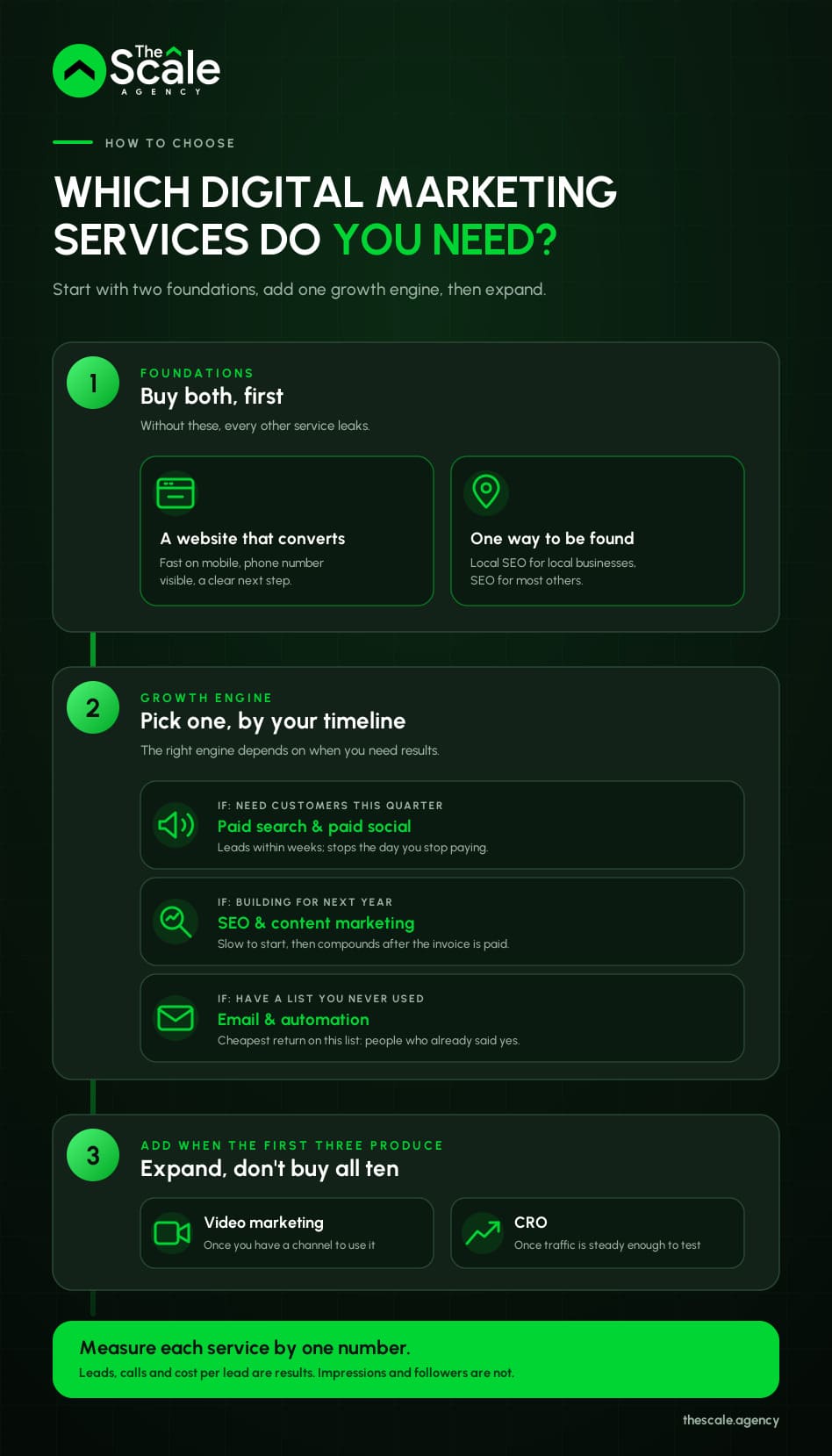
Start with two foundation services, then add one growth engine. The foundation is a website that converts and one way to be found: local SEO for most local businesses, SEO for most others. The growth engine depends on timing: paid ads if you need customers this quarter, SEO and content if you are building for next year, email if you have a customer list you have never used. Add video and CRO once the first three are producing. For the bigger picture of how it all fits, the 360-degree marketing approach explains the strategy side.
If you are a small or local business
Digital marketing services for small business should start with the cheapest wins: a complete Google Business Profile, a steady ask for reviews, and a phone number visible on every mobile page. Those cost almost nothing. Only after that does paid search make sense, and only for searches that mean someone is ready to buy.
If you sell online
Ecommerce digital marketing services look different because the sale happens on the site. Paid social and shopping ads bring the traffic, CRO and site speed decide how much of it buys, and email recovers abandoned carts. SEO for product categories matters too but is slower, so most stores run ads first and build SEO alongside.
If you sell to other businesses
B2B digital marketing services lean on content and LinkedIn because buyers research for weeks and involve several people. A comparison guide, a case-study page and a nurture email sequence usually do more than a broad social presence. Paid search still works for high-intent terms, but the landing page and follow-up matter more than the click.
If you need results this quarter versus next year
Paid ads produce leads within weeks and stop the day you stop paying. SEO, content and email take longer and keep working after the invoice is paid. A healthy plan runs one of each, and knowing which stage of the funnel each service serves shows why a business cannot live on ads alone.
Agency, in-house, or an augmented team?
What services do digital marketing agencies offer? Full-service agencies cover everything on this list; specialists cover one or two. A third option, staff augmentation, places a specialist inside your team under your direction, for companies that have a marketing lead but not the hands. Whichever model you choose, the services work better together than apart, so if you buy several, learn how to run all of them from one integrated marketing plan rather than managing them as separate vendors; that guide also covers the in-house versus agency trade-offs.
Four mistakes to avoid when buying marketing services
1. Buying ads before the website converts. Traffic to a weak page is the most common way small businesses lose money on marketing.
2. Paying for all ten at once. Nobody needs the full list in month one. Two foundations and one engine is enough to learn from.
3. Judging SEO after six weeks. It is the slowest service here and the only one that compounds; give it two quarters.
4. Letting the agency own your accounts. Google Ads, Google Business Profile, your domain and your analytics should always be in your name.
Conclusion: start with two, add the third when the first two work
The types of digital marketing services are easier to choose once you stop treating them as a menu. Fix the website, get found where your customers already look, add one engine that matches your timeline, and measure each by a single number. When the first two are producing, you will know which third to add. To see what that looks like as a plan, you can see how The Scale Agency prices its services and talk through which two to start with.


