+1 877 33 SCALE

You already know you need digital marketing. You probably have a website, a couple of social accounts, and a list of things people have told you to try. What's missing is the order: what to do first, what can wait, and what to skip for now.
Here is where to start with digital marketing. Pick one measurable business goal. Put the free online basics in place and make sure your main web page turns visitors into inquiries. Then choose one marketing priority, run it long enough to learn from it, and expand only when the numbers tell you to.
Digital marketing for small business works best in that order, because each step makes the next one cheaper and easier to measure. Using five tools at once mostly creates five half-finished projects. Whether you call it online marketing for small business or internet marketing, the plan below covers your first 90 days.
Why Digital Marketing Is Important for Small Business
People look a business up online before many buying decisions. They check what you offer, where you are, and what other customers say.
Having a website doesn't guarantee they'll find you or contact you. A site nobody visits, or one that doesn't make the next step obvious, is a brochure in a drawer.
Small business digital marketing gives you ways to reach the people who are already looking for what you sell. It also gives you something older advertising rarely did: measurement. You can see which activity produced inquiries and which didn't, and put your next dollar where it works.
Before You Spend Anything: Decide What You Want
A digital marketing strategy for small business can fit on one page. It needs three decisions.
- What result are you working toward in the next 90 days? Give it a number: 15 quote requests a month, 40 booked appointments, 100 online orders.
- Who is your most valuable customer? Describe one real type of buyer, the problem they have, and what they'd type into a search box.
- What single action should a visitor take? Call, book, request a quote, or buy. Choose one.
These answers decide which page you improve, which channel you choose, and what you measure. If you want to see how a stranger moves from first search to purchase, our guide to the digital marketing funnel explains each stage.
How to Start Digital Marketing for a Small Business: Your First 90 Days
This digital marketing plan for small business owners is organized by time, not by marketing service. Each stage prepares the next.
Week 1: Put the Free Basics in Place
None of these steps costs money. Together they take a few hours.
- Claim or review your Google Business Profile, if your business serves customers in person or in a service area. It's the listing people see in Google Maps and local results.
- Open your website on your own phone. Tap the phone number. Submit the contact form. Make sure every message reaches someone.
- Set up Google Search Console. Its Performance report shows which searches and pages already bring visitors from Google.
- Set up Google Analytics 4. It shows where visitors come from and what they do on your site.
- Mark your important actions as key events. That means form submissions, bookings, or purchases. Without this, you can count visitors but not results.
For a quick outside view, our free Marketing Report Card scores your site across six areas, including content, SEO, and AI presence, in about 30 seconds.
Days 8 to 30: Fix the Page People Land On
Before you invite more visitors, fix the page most of them will see first. Often that's your homepage or your main service page.
Check that it has:
- A headline that says what you offer.
- A line that says who it's for and where.
- One prominent next step, such as "Get a free estimate."
- A visible phone number and a short form or booking tool.
- Genuine reviews or photos of real work.
Picture a flooring store in Tulsa whose homepage opens with "Welcome to our showroom." Changing it to "Hardwood and tile flooring, installed for Tulsa homeowners," with a "Get a free estimate" button and three customer reviews beneath, tells a visitor what you do at a glance.
Then ask five recent customers for an honest review. Send them the direct link. Don't offer discounts or gifts in return, and don't ask only the customers you expect to be positive.
Days 31 to 60: Pick One Channel and Run It Properly
Now choose one priority. The best digital marketing for small business depends on how your customers already behave, your goal, your time, and the demand that exists today. Use this table as a starting point, not a rule.
| Business situation | A suitable starting priority | What to work on |
| People actively search for your service | Search visibility (SEO) | A clear page for each service, plus useful answers to common questions |
| You serve a defined local area | Local visibility | Business Profile, reviews, accurate location details |
| You need faster visibility for a specific offer | Paid search advertising | A focused campaign and a landing page that matches the ad |
| Past customers could buy again | Permission-based email | Useful updates and follow-up |
| Customers judge your product by how it looks | Social content | Regular product demonstrations and helpful posts |
An electrician and an online candle shop will pick different rows, and both can be right. To explore each option in more detail, see our overview of the types of digital marketing services.
It's also worth knowing how your business appears in AI-assisted search, where tools summarize answers for the searcher. Improving that is often called answer engine optimization. It builds on clear, original, accurate content, and nobody can guarantee a mention.
Days 61 to 90: Keep the Customers You Win, Then Review
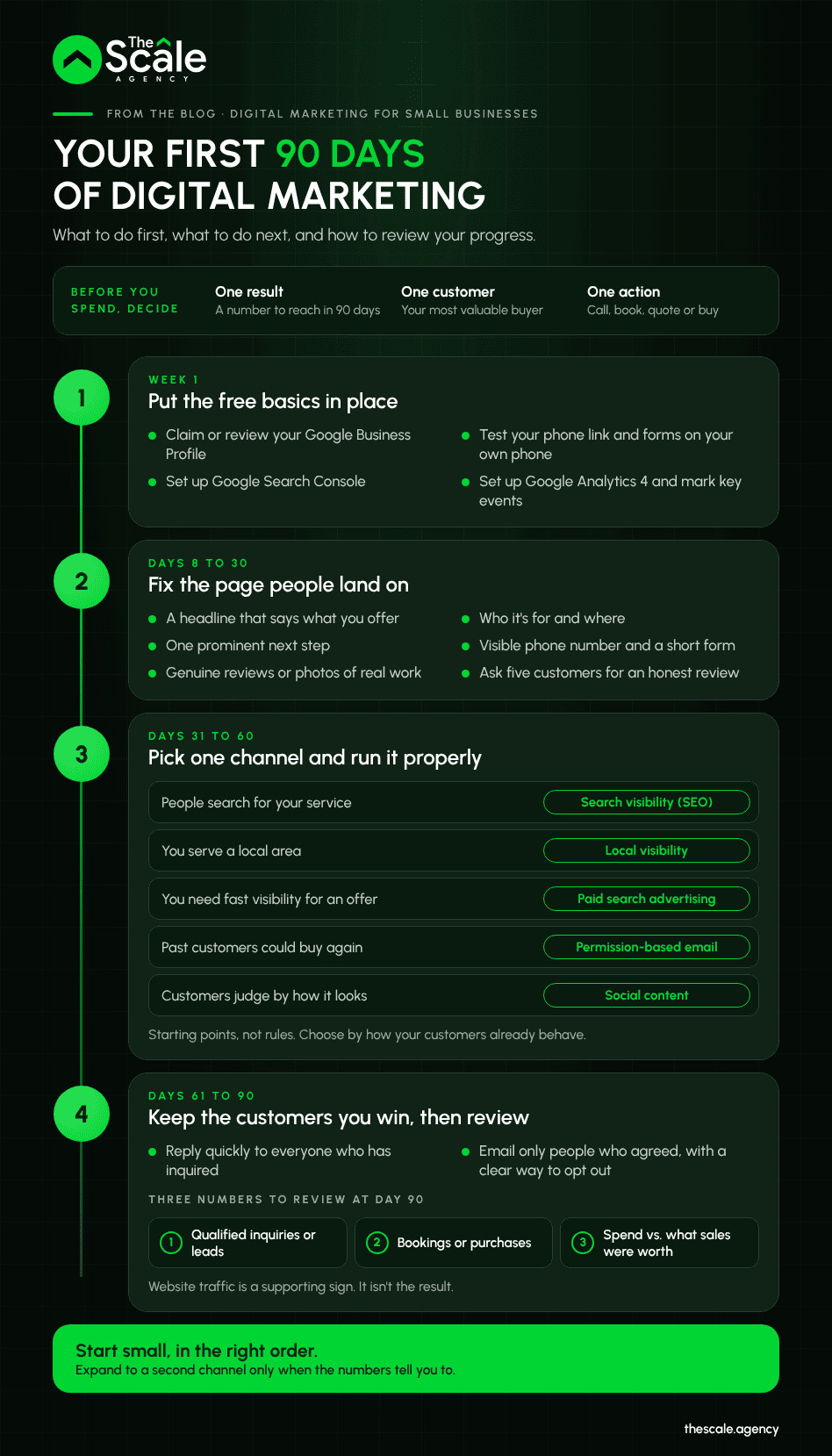
Reply quickly to everyone who has inquired, and stay in touch with the customers you've already won.
Email is the simplest way. Send useful messages only to people who agreed to hear from you. US law also sets rules for commercial email. The FTC's CAN-SPAM guide explains the requirements, which include accurate sender information, honest subject lines, a valid postal address, and a clear way to opt out. Opt-out requests must be honored within 10 business days. Read the guide before your first send.
At day 90, review three numbers:
- Qualified inquiries or leads.
- How many became bookings or purchases.
- What you spent compared with what those sales were worth.
Website traffic is a supporting sign. It isn't the result.
Digital Marketing Strategy for Local Business: What Changes
Digital marketing for local business follows the same order, with more attention on being found nearby. An online-only shop competes everywhere. A local business competes in a few zip codes.
Google says local results are based mainly on relevance, distance, and prominence. Relevance is how well your profile matches the search. Distance is how far you are from the searcher. Prominence is how well known your business is, which partly reflects reviews. Google also states there is no way to request or pay for a better local ranking.
So focus on what you control:
- A complete, accurate, verified Business Profile with current hours.
- Genuine reviews, each one answered.
- The same business name, address, and phone number wherever you're listed.
- Clear service-area details and pages about the places and services you cover.
- Easy ways to call, book, or request a quote.
A mobile dog groomer in Tampa gains more from that list than from a daily posting schedule. It improves your chances. It can't promise a position.
How Much Should a Small Business Spend on Marketing?
There's no single figure that fits every business. The right small business marketing budget depends on your revenue and cash flow, what a customer is worth over time, how fast you want to grow, and how much of the work you can do yourself.
One number gets quoted often. An archived U.S. Small Business Administration blog post, saved in 2012, suggested that businesses with under $5 million in revenue allocate 7 to 8 percent of revenue to marketing. It is historical guidance, not a current official rule.
A more practical method is to work backward from the value of a customer.
Hypothetical example: A flooring store's average job is $6,000, with 30 percent gross profit, or $1,800. The owner decides that spending up to $300 to win one job is reasonable. A goal of ten extra jobs in 90 days supports a budget of about $3,000.
If customers buy repeatedly, as they might from a bakery, you can afford more per new customer.
Your digital marketing budget for small business has two parts: what you pay for ads, and what you pay in time or fees to manage the work. Affordable digital marketing services for small business owners usually mean a narrow scope done well.
Do It Yourself or Get Help?
Many owners can handle the basics: keeping business information accurate, collecting customer feedback, checking that contact details work, setting goals, and reviewing simple analytics. Google's own guidance says a small local business can probably do much of the SEO work itself.
Some work usually needs specialist skills: technical SEO, advanced analytics setup, paid advertising optimization, complex website changes, and a strategy that connects several channels.
Outside help may be worthwhile when:
- Marketing eats your time and there's still no clear process.
- You can't tell which activities bring in customers.
- Technical or strategic problems need skills your team doesn't have.
What Does a Digital Marketing Agency Do for Small Businesses?
A digital marketing agency helps a business clarify its goals, build a practical plan, improve its online visibility, coordinate the marketing activities that fit, measure performance, and find ways to improve results. A good one starts with your goal and your numbers.
One example from our own work: for Dump Truck Kings, a family-owned commercial truck dealership in California, we ran a Meta lead ads campaign with a total spend of $1,177.79. It produced 92 leads, and the client confirmed about $208,000 in revenue from them, as the Dump Truck Kings case study describes. The revenue figure is client-reported, and results like this are not typical or guaranteed.
5 Mistakes to Avoid When You're Starting Out
Most digital marketing tips for small business owners tell you what to add. These are things to avoid.
- Starting several channels at once. Pick one and learn it first.
- Running ads before tracking conversions. Set up key events first, or you'll pay without learning anything.
- Judging results too early. Decide the review date in advance and wait for it.
- Relying only on social media. Send people to a website you control, with a clear next step.
- Chasing followers. Count inquiries, bookings, and sales.
Start Small, in the Right Order - Digital marketing for small business doesn't require doing everything. Set a goal. Put the basics in place. Fix your most important page. Choose one priority, measure real results, and expand based on what you learn.
- For a starting score, run the free Marketing Report Card on your site. When you're ready to connect several channels, read how 360-degree digital marketing works, or talk with our full-service digital marketing team.